The Poetic Edda, the sagas, the law codes, the runic inscriptions on stone — nearly everything we have of Norse text was produced by men. Many of them were Christians writing two centuries after the pagan world had ended. The women of that world left almost no written record.
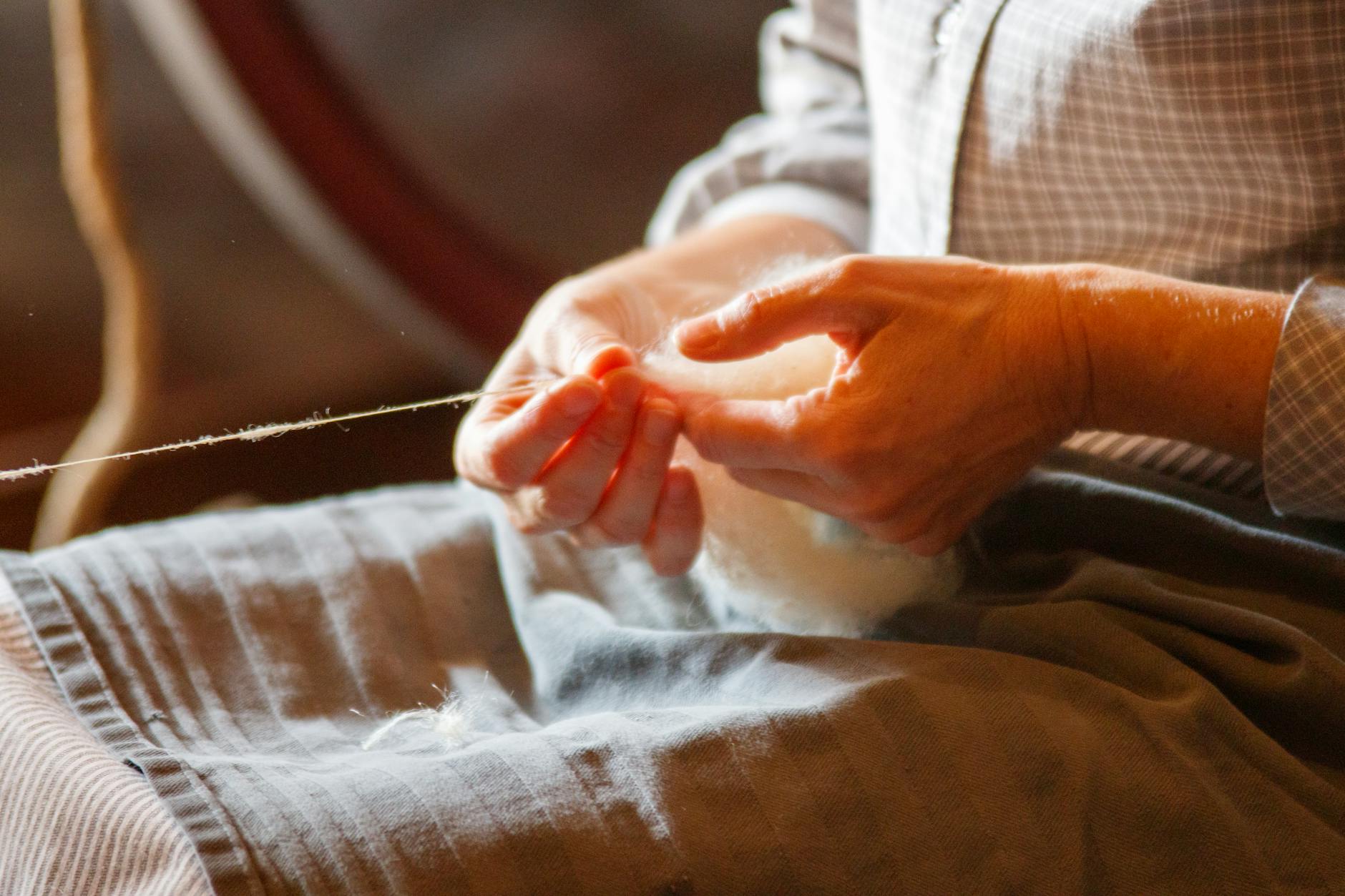
They did, however, leave thread.
Weaving as a language
The textile evidence from Viking-age Scandinavia is vast and badly underutilised. The Oseberg ship burial (c. 834) preserved a collection of tapestries fragmentary enough to frustrate every scholar who has looked at them and rich enough to keep people looking. The Överhogdal tapestries (probably eleventh century, from Sweden) show complex scenes of ships, horses, warriors, and sacred trees, stitched in techniques that had been in use for five hundred years before they were made.
The women who made these textiles were not doing craft in the modern decorative sense. They were doing work that the society required, using a medium the society read. A wall hanging in a long-hall was, among other things, historical record — the exploits of the family, the dedication of the land, the alliances remembered. Saga-writers refer to such hangings casually, assuming the reader understands that they spoke as clearly as any text.
Bayeux, famously, is the one piece of this tradition that survived into our central historical canon — a seventy-metre embroidery produced by English women in the decades after the Norman Conquest, recording the events in such detail that it remains a primary source for the invasion of 1066. It was women's work. It was also the most important single piece of eleventh-century historical testimony outside the chronicles.
The Norns — what they actually do
The Norns are three women who sit under the world-tree Yggdrasil. Their names are Urðr, Verðandi, and Skuld — past, present, and that-which-must-become. They tend the tree. They water its roots from the well. They determine the fate of every human at birth.
What they are described as doing in the Eddic poems is often translated as "weaving fate." In Völuspá the fate of the world is spun and cut by their hands. In Hamðismál and elsewhere, the image is consistent: the life of each person is a thread, and the three Norns control its length, its colour, and its termination.
This is not only metaphor. The metaphor is a reflection of what women in the society actually did — and the fact that the Norns were imagined as three weaving women tells you what kind of work women's weaving was felt to be. It was the work of determining the shape of what lay ahead. The woman at the loom was making something real; the three Norns were making the world, and the imagined act was the same act.
The valkyries' loom
Darraðarljóð is one of the most unsettling poems in the Old Norse corpus. Preserved in Njáls saga, it describes a vision in which twelve valkyries are seen weaving on a loom strung with human entrails, weighted with heads, shuttled with arrows. They are weaving the fate of the Battle of Clontarf (1014). As they weave, they sing the outcome of the battle.
Read this carefully. The valkyries are women. They are producing history. The medium is explicitly a loom. The product is simultaneously a textile and a prediction. The poem is, among other things, a fierce and unsentimental description of what women's weaving was understood to be in the older imagination: a form of telling, of shaping, of cutting.
No Christian monk would have dreamed this up. The poem is a remnant of a tradition that treated women's craft as an oracle.
Why women's craft was dismissed
By the nineteenth century, when Norse literature was being translated and catalogued for English-speaking audiences, the textile tradition was almost invisible. The reason is simple: the translators were men, the scholars were men, and what they considered worth preserving were men's texts. The sagas got anthologies; the tapestries got stored in provincial museum basements.
This is not a conspiracy theory. It is how canon-formation works. The things that look like what the canoniser values get counted; the things that do not get ignored. A Viking-age poet's kenning gets three scholarly footnotes. A Viking-age weaver's tapestry of the same event gets a line in a conservation report.
One of the things the modern revival of this tradition has to do — quietly, without fanfare — is put the textile record back where it belongs, which is next to the written record, not behind it.
Thread as memory
I keep a small piece of weaving in my house that my grandmother made. It is not impressive. It is a square of wool, badly dyed, partly moth-eaten. I have it on the wall not because it is beautiful but because it is a record of her hands.
The modern version of what the old women did is not usually weaving — very few of us spin wool now, and even those who do are working in a recovered craft rather than an unbroken one. But the impulse survives. Women keep things. Photographs. Letters. A child's first drawing. The things that are kept become the record, even when no one is writing anything down.
If you are looking for a practice to carry from this tradition, it is not necessarily the loom. It is the keeping. What in your line deserves to be preserved? What would you weave into the fabric of the household if you were sitting at the loom in the old sense? Identify it. Keep it. The act of choosing to keep is the act of remembering.
Closing
Every woman in this tradition is a descendant, knowingly or not, of the women at the loom. What they wove is mostly gone. What survived got into museum storage, or was attributed to men, or was lost in a farmhouse fire in 1823. What is left is the shape of their absence, and a very clear instruction from the poems: the woman at the loom is making history. Take the instruction seriously. Keep what deserves to be kept. Record what deserves to be recorded.
The thread is still there in your hands.
Leave a note in the margin
Thoughtful disagreement welcomed. Promotional links quietly removed. First-time notes are read before they appear.