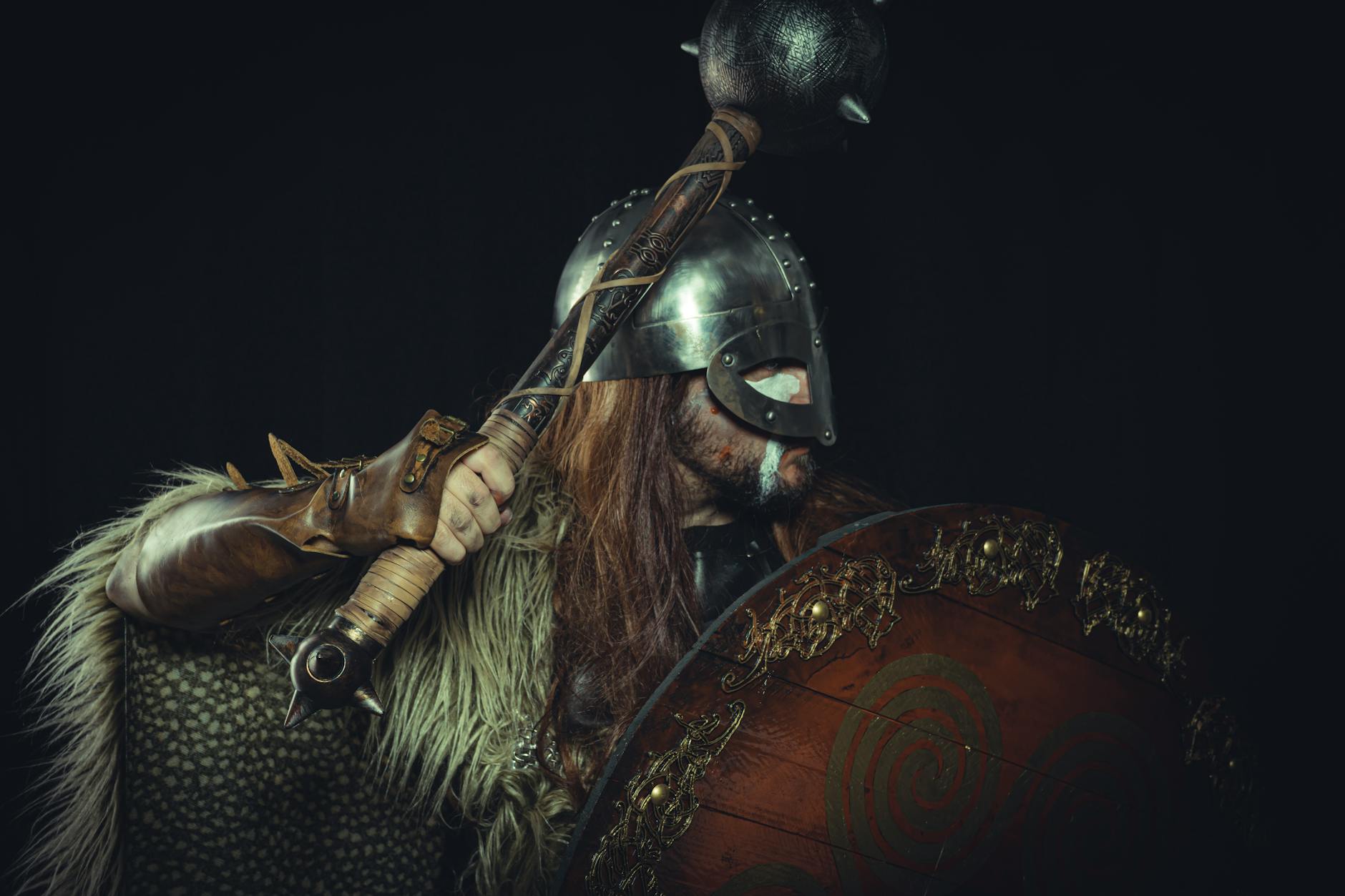
In 2017, a paper in the American Journal of Physical Anthropology confirmed what Neil Price and Charlotte Hedenstierna-Jonson had suspected for years: the occupant of grave Bj.581 at Birka, Sweden — a tenth-century burial containing two horses, a sword, an axe, a spear, armour-piercing arrows, two shields, and gaming pieces marking the occupant as a strategist — was a woman. The body had been catalogued as male since its excavation in 1878, because women were not supposed to be buried with that configuration of grave goods.
The DNA said otherwise. The women of the North had been burying their warriors like this, at least some of them, for centuries before anyone thought to doubt the bones.
What the sources actually say
The Old Norse word is skjaldmær — "shield-maiden." It appears in several sagas and in Saxo Grammaticus's Gesta Danorum, a late-twelfth-century Danish history that gathers older oral material. Saxo describes whole bands of them; he names Lagertha (who became the wife of Ragnar Loðbrók), Hervör in Hervarar saga ok Heiðreks, and a handful of others. The saga writers treat them with a mixture of admiration and unease. They are real enough in the texts to be named; rare enough to be remarked upon.
Modern scholarship is cautious. Neil Price — whose The Viking Way and Children of Ash and Elm are the best recent English-language surveys — argues that the shieldmaiden was a real if exceptional role in Norse society, documented in both the textual tradition and (now) the archaeological record. Judith Jesch is more sceptical, pointing out that most saga references are literary. Both positions are defensible. What is no longer defensible is the older position that no Norse woman ever took up arms.
What shieldmaiden actually meant
It was not a military rank in the modern sense. There were no regiments of shieldmaidens. The sagas describe individual women who took up arms under specific circumstances — usually in the defence of a household, sometimes in legal vengeance, rarely as raiders in their own right. Hervör in the eponymous saga takes up arms to recover her inheritance. Lagertha, according to Saxo, commanded troops in battle. These are specific women in specific situations, not a general category of soldier.
What the shieldmaiden role required, crucially, was permission. The household had to accept it; the woman had to be competent at it; the neighbours had to recognise it. It was not, as far as we can tell, looked down upon when the circumstances warranted it. It was not encouraged in normal times. A woman whose husband was alive and whose farm was secure did not train for battle. A woman whose husband had been killed and whose estate was being threatened might take up his shield and keep what was hers.
The shield arm mattered more than the sword arm
Any reconstruction of Norse-era fighting will tell you this. The sword arm does the dramatic work — the cut that the sagas like to describe. The shield arm does the work that keeps you alive.
A tenth-century round shield weighed between three and five kilograms. In a wall-fight it was held up, angled slightly forward, for minutes at a time. The muscle group that took the load was the rhomboid-and-lower-trapezius system — the muscles that pull the shoulder blade down toward the spine. This is also the muscle group that collapses first in people who spend eight hours a day at a desk.
If you want to train for strength in a way that has some continuity with the older practice, this is the honest place to start: not the grip of the sword, but the set of the shoulder. Not the arm that cuts, but the arm that holds its line.
How to carry this now without cosplay
I am not going to tell you to buy a shield. Unless you are specifically training in historical European martial arts — in which case, go well and with good teachers — there is no reason to own one.
What I will tell you is this. The old shield-training was, at its root, a discipline of keeping your body in a state where you could defend your place. A modern woman whose place is a house, a laptop, a child, a career has the same underlying requirement. You need to be strong enough in the back, the hips, and the feet to hold your ground when something comes at you — physically, yes, but also the other kinds of coming-at-you that modern life specialises in.
The practice I keep, and recommend:
- Deadlift, or learn to. Not ideologically. The deadlift is the lift that trains the posterior chain — the line from the heel up through the back of the thigh, through the glute, up the back, to the shoulder. That line is what made the shield-wall possible. It is also what lets a modern woman carry groceries at 70 without falling. Start light. Learn the form from a competent teacher. Keep it for forty years.
- Carry heavy things. A sandbag. A weighted pack. A child. The old women were not strong because they lifted weights; they were strong because they moved weight. The modern version is the Zercher carry, the farmer's walk, the trip up the stairs with the laundry basket loaded.
- Hang. From a bar. From a tree branch. As long as you can, regularly. The grip is the most underrated strength marker in most modern women's lives. A woman who can hang for thirty seconds is almost never a woman who can be knocked down.
- Walk outside in any weather. This is not romantic. It is the oldest conditioning discipline we have. A mile a day, done in the rain, in the cold, in the summer heat, accumulates a cardiovascular and skeletal resilience that no indoor routine matches.
What strength actually is
The cultural story about women's strength is either performative (gym-selfie, aesthetic) or protective (fragile, keep safe). Neither is what the shieldmaiden tradition was about. Strength in the older sense was capacity — the capacity to hold a position, to carry a load, to stand up under pressure without buckling. It was not a look. It was an instrument. The women who had it carried it as casually as they carried the keys at their hips.
That instrument is available to any modern woman who is willing to train it. It does not require a gym, a coach, or a specific body. It requires that you pick up something heavy most days of the week and put it down well, and that you do this for decades rather than months.
Closing
The woman in grave Bj.581 was around thirty when she was buried. She had trained for her craft. Her bones showed the small asymmetries of a fighter. The society that buried her did so with honour. She was not exceptional because she was a woman. She was exceptional because she was good.
The inheritance she leaves you is not a set of weapons. It is the much simpler and more demanding instruction to train your body as if it mattered, because at the turn of any given year it will.
Leave a note in the margin
Thoughtful disagreement welcomed. Promotional links quietly removed. First-time notes are read before they appear.