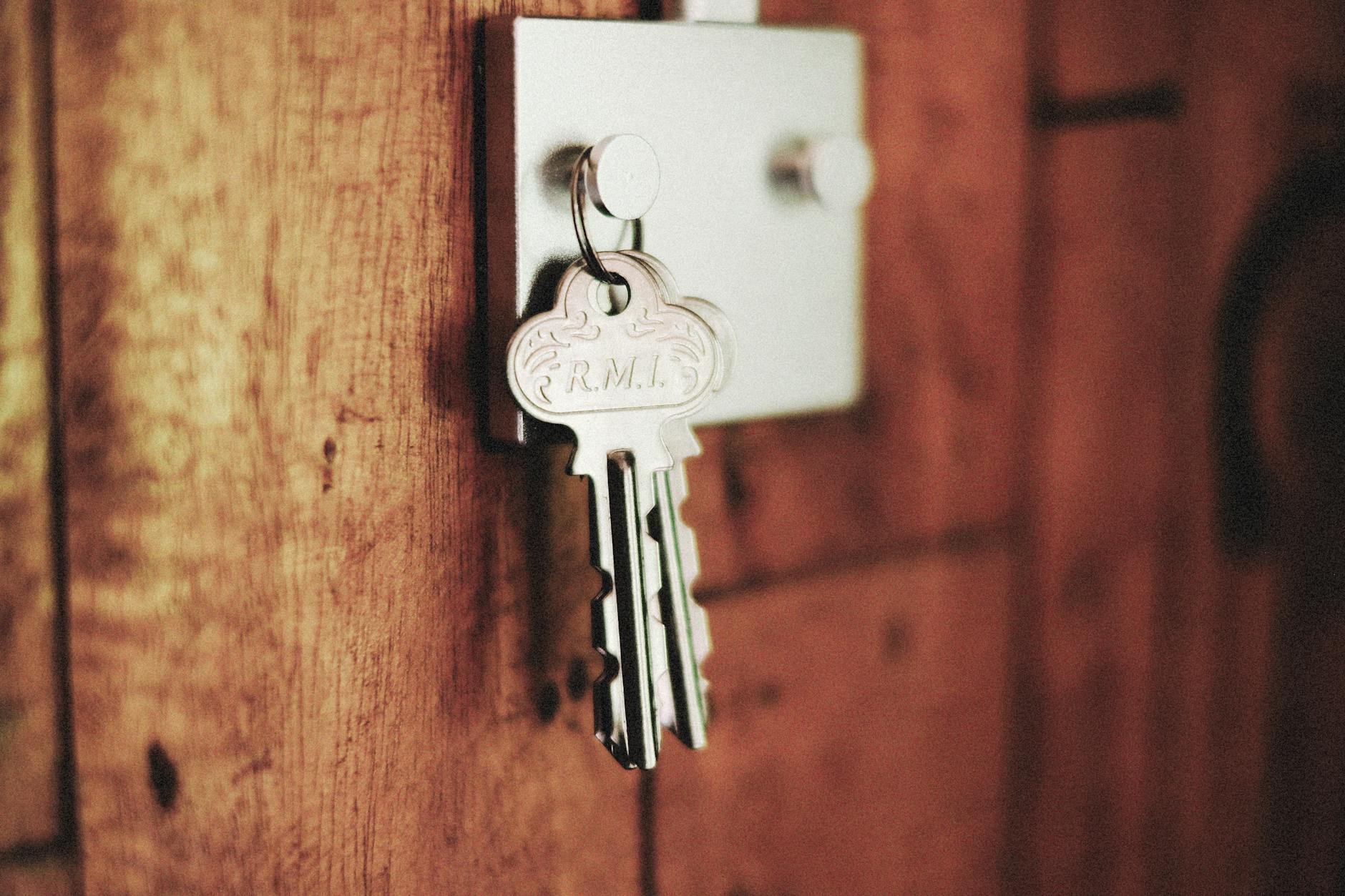
The woman who kept the hearth in tenth-century Iceland carried the keys of the household on a ring at her hip. The keys were not decoration. They meant something.
I want to begin with the keys because they will do most of the work of this essay for me. A húsfreyja — literally "house-lady," though that translation does her no favours — wore a ring of keys on her outer garment. The ring usually held a key to the outer door of the house, a key to the pantry (matarbúr), and a key to the chests where the family's precious goods were locked. When she stepped out of the farm to walk the fields or take her baby to be blessed, the keys went with her. When she died, the keys went to the woman who would succeed her — her daughter, her daughter-in-law, or the senior woman of the household.
This is one of the quiet facts about Old Norse household life that becomes, if you sit with it long enough, very loud. The keys meant she controlled access. She controlled stores. She controlled the distribution of what the household had. A man who wanted to feed his guests had to ask his wife. A guest who wanted a meal sat in her hall.
None of this is sentiment. I am not making her out to be a secret chieftain. She did not go to the Thing on her own behalf in any normal year. She could not speak at the law-rock. She was under her husband's jurisdiction in legal contexts and under her father's before that. But within the bounds of the home — which, in a society where the farm was the basic political unit of the landscape, meant something very different than the word "home" means to us — she held an office. A recognisable, legally-shaped office with rights and responsibilities attached to it. Not a role. An office.
What the word actually meant
The Old Norse húsfreyja is built from hús (house, estate) and freyja (lady, mistress — the same root as the goddess Freyja's name). It appears in the sagas in contexts where the woman in question is being addressed with deference by someone who has come into her house. Saga women are routinely called húsfreyja by servants, by guests, by their husbands in public settings. The word is not analogous to modern "housewife," which in English is a twentieth-century coinage implying someone whose productive work is invisible. A húsfreyja's work was not invisible. It was the work that kept the household solvent.
It is easy, reading the sagas in translation, to miss how much of the economic activity of the farm was run through her. She supervised the dairying, which in a sheep-and-cow economy was the difference between a household that could trade and one that could not. She directed the textile production — and in the saga period a single trading voyage might be financed by the wool cloth she and her daughters had spent the winter weaving. She oversaw the brewing, which mattered not only for consumption but for the obligatory ritual of hospitality: a household that could not brew good ale for its guests was shamed. The rhythm of the farm's year was the rhythm she set.
Jenny Jochens, whose work on women in Old Norse society is still the clearest English-language account, puts it plainly: the management of the home economy was entirely in the hands of the women of the household, and without them the farm did not function.
The legal shape of the office
I want to make the legal part of this concrete, because it is where the modern word "housewife" really breaks down as a translation.
When a couple married, the woman brought a heimanfylgja — a dowry payable by her father. Her husband paid a mundr — a bride-price payable to her family. Crucially, the mundr did not disappear into the marriage: it belonged to her, administered during the marriage by her husband, and returnable to her in the event of a divorce. The Grágás — the law code of the Icelandic commonwealth — treats her property and his property as separate. She could own land. She could inherit. She could bring a case through a male kinsman, and if he did not press it, she could shame him until he did.
The most famous example of a saga woman using this leverage is in Laxdœla saga, when Guðrún Ósvífrsdóttir, injured by a husband she did not want, lays out her case so precisely that her father cannot avoid pursuing it. She is not a housewife asking permission. She is a woman with a legal instrument in her hand.
This did not make these women equal to their husbands. It made them counterparts. The whole social architecture of the farm assumed two offices in counterpoint: the one held by the bóndi (the freeholder) and the one held by the húsfreyja. Remove either, and the farm failed — economically, socially, ritually.
The saga women who held the office
Read Bergþóra Skarphéðinsdóttir, Njáll's wife in Njáls saga. She does not speak often, but every time she does, the saga records it carefully, because her speech has weight. When she tells her sons to avenge their uncle, they go. When she refuses to abandon her husband as the farm burns around them, the saga writer pauses the carnage long enough to record her exact words.
Read Bera Yngvarsdóttir in Egils saga. A mother who feeds her difficult son not what he wants but what he needs. Who watches him become Egill Skallagrímsson without ever losing her own ground inside the house.
Read Aud the Deep-Minded — Auðr in djúpúðga — who led her whole household out of Norway and Caithness into the empty land of Iceland, claiming territory for herself and her descendants, who was honoured in her own right as a settler. Whose freed slaves took her name as their patronymic. Whose house was a centre of early Christian practice on the island long before it became normal.
These were not exceptions. They were women operating inside the normal expectations of their office. What made them remembered was their excellence at it, not their deviation from it.
Why this matters now
I am not trying to argue that you should do what Bergþóra or Aud did. Those were women of a specific place, at a specific time, embedded in a specific economy. The life of a modern woman is not their life.
What I am trying to say is that the older tradition understood running a household to be a named role. It was not invisible. It was not "just what women do." It was the húsfreyja's office, and the office had authority attached to it because the authority was required in order to run the thing. If the keys were decorative, the farm starved.
I think a lot of modern women who have come to the old ways because they felt something missing in their inherited religion are, without knowing it, looking for this. Not to be restored to the farm. To be restored to the sense that the work they do in the household — the feeding, the keeping, the tending, the decisions about what enters and what is kept out — is a real office rather than a residue.
You can pick that back up without any props.
A small practice, if you want one
I am not going to tell you to put literal keys on your belt. Most of us don't have that kind of life, and cosplaying an Icelandic farmwife is exactly what I am trying to argue against.
But I will tell you what I do.
Once a week, at the same quiet hour, I sit down and write a short list of what is in the house that I am responsible for. Food. People. The animals. The records. The things I am choosing to keep and the things I am choosing to let out. I do not make the list out of anxiety; I make it the way someone balancing accounts makes a list. The act of writing it is an act of claiming the office — of saying: these are my keys, and I am keeping them.
Then I put the list in a drawer and get on with my week.
This is not a rite in any formal sense. But it sits where a rite would sit. And over the years it has changed the way I carry myself in my own house.
Leave a note in the margin
Thoughtful disagreement welcomed. Promotional links quietly removed. First-time notes are read before they appear.