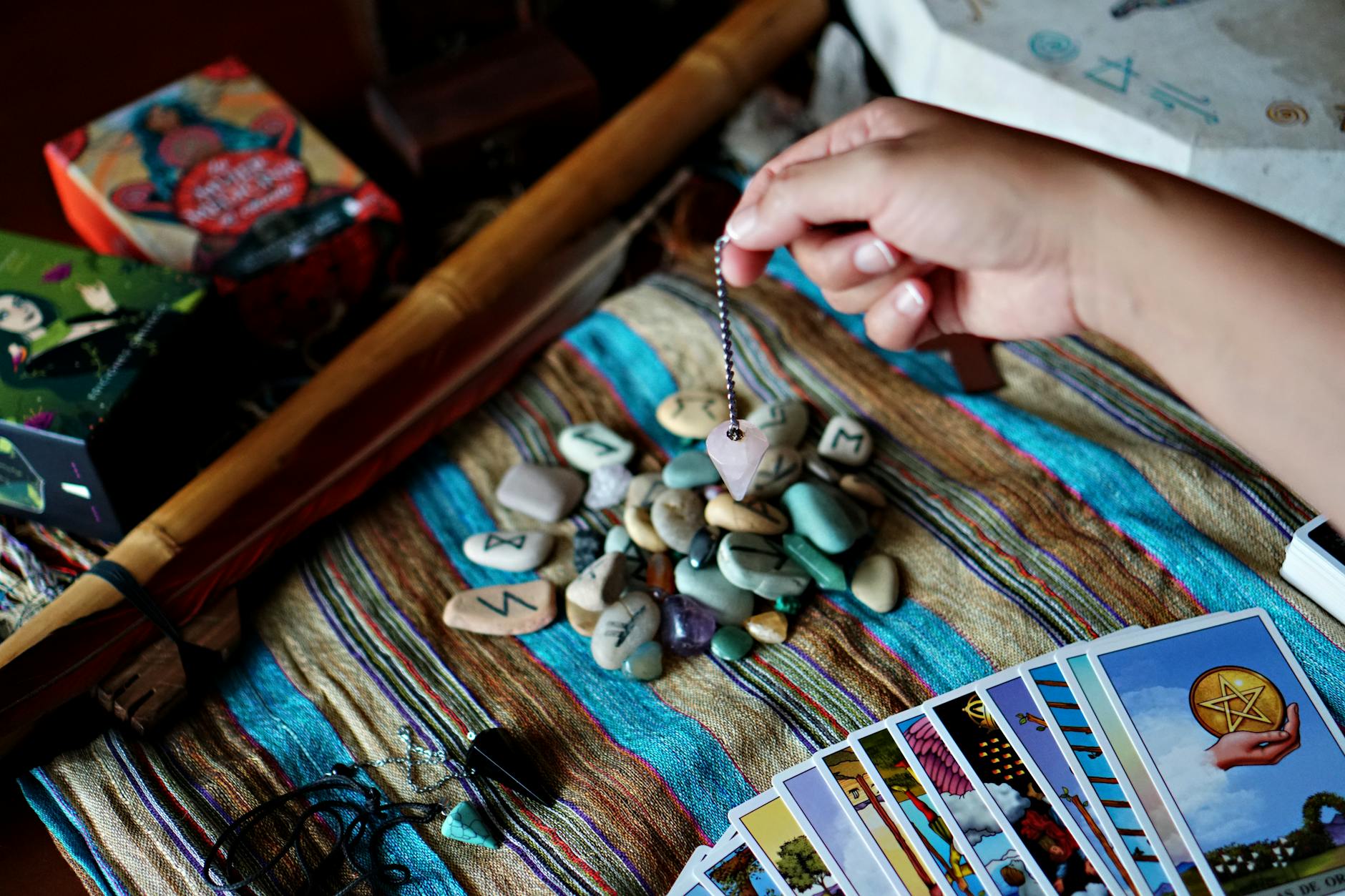
The rune poems are short. They do not explain themselves. They were written down long after the women who were actually reading the runes had stopped writing anything down, and you can tell.
I want to start with something uncomfortable: a lot of what passes for "rune reading" today is downstream of one book — Ralph Blum's Book of Runes (1982) — which was not a recovery of anything. Blum freely admitted he had no scholarly training in runology, invented his own keywords (including one blank rune that does not exist in any primary source), and sold the set well. The system he devised is what most shop-bought rune sets still carry with them. This is the tradition you inherited if you came to runes through crystals and essential oils. It is not a tradition that connects to the women who used runes a thousand years ago.
I am going to tell you how to work with runes the way the evidence suggests they were worked. Some of this will be austere. Most of it will be quieter than you expect. None of it requires a crystal.
What the rune poems actually are
We have three rune poems. The Old English Rune Poem (tenth century, preserved in a tenth-century manuscript that was destroyed in the Cotton Library fire and survives only because it was copied before). The Norwegian Rune Poem (thirteenth century, from an Icelandic manuscript source). The Icelandic Rune Poem (fifteenth century). They are each a series of short stanzas, one per rune. They are not divinatory manuals. They are mnemonic riddles.
The first rune, Fehu (ᚠ), is one of the easiest to translate across all three poems. In the Old English, it reads in R.I. Page's translation: Wealth is a comfort to every man; yet every man must give it away freely, if he wishes to gain glory in the sight of the Lord.
Note what has already happened: a rune that represents cattle — mobile, distributable wealth — is being worked up by the poem into a gnomic truism about generosity. The Old English poet, a Christian monk, was drawing on an older pagan memory and editorialising it. The Norwegian poem does the same trick from a different angle. Fehu stays stable across the traditions — it means wealth, cattle, mobile abundance, what you have that can be given — and every tradition agrees that what you do with that wealth determines who you are.
A woman in tenth-century Iceland drawing Fehu out of a cast was not asking "what does Fehu mean." She knew what Fehu meant the way you know what October means. She was asking: what is Fehu doing in this cast, in this position, on this day, for this question.
The craft, as the evidence describes it
The phrase rún at rísta — to cut a rune — appears often in the sagas. It implies that the runes were cut, not drawn. The medium is a surface that can be scored: wood, bone, metal, stone. The word rún itself has older meanings that gather around secret, whisper, confidence. The runic craft was, in the women's hands who are hinted at in the sagas, associated with knowing what had not yet been said.
The famous passage is in Egils saga, where Egill heals a sick woman by finding and destroying poorly-cut runes that a young man had put under her pillow while trying to make her love him. The young man is called a bungler in the saga; Egill cuts proper runes, and the woman recovers. The lesson is not that runes are magic. The lesson is that a rune cut wrongly is worse than no rune at all.
The implication — and it is not more than an implication — is that there was a class of people in this society who could cut runes correctly and a much larger class that should not try. The women named as wise, called völva or spákona, are hinted at in this class. The sagas are not forthcoming about what these women actually did, because the sagas were written down by men, in a Christian century, reconstructing a practice they had only partial access to.
What we can recover is this: the craft involved cutting, not drawing. It involved a grave question, not a casual one. It involved a willingness to let the wood say what it said.
Three runes worked at real depth
Instead of giving you the whole alphabet in keywords — which is the Blum move — I will work three at real depth, so you see the shape of what reading them is like.
ᚠ Fehu
The Old English poem emphasises generosity; the Norwegian emphasises strife. In a cast it means: your wealth is present. What are you doing with it? Note that the sagas are full of households destroyed by inheritance disputes — Fehu is the rune of what is disputable. If it falls into your reversed position, I would not read it as "loss of money." I would read it as "something in your possession is about to be questioned, and the question will come from someone close to you." That is the older sense.
ᚦ Thurisaz
The rune of the thorn. Old English: Ðorn byþ ðearle scearp — thorn is severely sharp. Norwegian: Þurs veldr kvenna kvillu — giant causes women's sickness. Icelandic, bleakly: Þurs er kvenna kvöl — giant is the torment of women. Thurisaz is the rune that does not flatter you. In casting, I have seen it come up for women who were about to make a decision that would look like self-harm to everyone around them and turn out, in the long arc, to have been the necessary incision. The thorn is not a wound. The thorn is the instrument that opens a wound so it can drain. It is the most misread rune in modern decks precisely because the modern person wants good news, and the thorn does not give good news; it gives true news.
ᛋ Sowilo
The sun. Old English: Sigel semannum symble biþ on hihte — the sun is always hope to sea-faring men. The rune of direction-finding, of orientation after a long uncertain night. Of the three here it is the plainest to read; it means what it appears to mean. The subtlety is that Sowilo does not guarantee arrival. It guarantees that you can see the way. Many things can happen on the way that the sun does not prevent.
You will notice none of these readings match what is printed on the card that came with your rune set. This is by design.
A method, austerely described
I do not use a velvet bag. I use a small linen one that my grandmother sewed and I have been patching since. The twenty-four runes of the Elder Futhark are on pieces of birch wood, each about the length of my thumb, cut by me in a winter I needed the task.
The procedure I follow is modest and close to what the evidence suggests. I ask a single, real question. Not "what is my week going to be like" — that is not a question, that is restlessness asking to be entertained. A real question. Then I reach into the bag without looking, and I draw either one rune (if the question is small) or three (if the question is large: the past, the present, and the turning).
I read what the rune says in relation to the question. I do not try to be clever. I let the rune do the work. If the reading disturbs me, I sit with the disturbance before I respond to it. Then I put the runes away.
When the reading disturbs you
This is the part Blum does not teach and the rune poems do.
The old evidence is very clear that a rune-cast could deliver news the asker did not want. It was understood that you were not consulting a friend. You were asking a sharp instrument to tell you the shape of something. If the instrument said Thurisaz, then Thurisaz was the shape. Your job was not to argue with the rune; it was to think carefully about what Thurisaz was doing in this position and what it would mean to act on that knowledge.
If the reading disturbs you and you cannot sit with it, do not cast again. The repeated asking is what the old attitude would call disrespect to the instrument and to yourself. The reading was already given. What you do with it is your work.
Closing
The runes are not a costume. They are not a horoscope. They were used by women who were running households in a harder world than ours with sharper instruments than ours, and they used them the way a surgeon uses a scalpel — only when necessary, and only for real cuts.
If you want to learn to read them, throw out whatever keyword booklet you have, read the rune poems in Page's translation, and sit with the three I have worked here until you feel them as shapes rather than words. The rest is time.
Leave a note in the margin
Thoughtful disagreement welcomed. Promotional links quietly removed. First-time notes are read before they appear.